
APS serves 1.4 million homes and businesses in 11 of Arizona’s 15 counties and is a leader in safely delivering reliable, affordable electricity in the Southwest. APS maintains a diverse range of energy resources, including nuclear from the Palo Verde Generating Station, natural gas, coal, solar, wind and energy storage – a mix that’s about 58% clean. With 140 years of experience serving Arizona, APS is the main subsidiary of Pinnacle West Capital Corp. (NYSE: PNW).
Header

APS Marks 140 Years of Serving Arizona with $1.4 Million Community Investment and Record Day of Service
- 140: years of service to Arizona
- $1.4 million: beautification projects across APS service area in 2026
- April 29, 2026: Day of Service for APS employee volunteers
PHOENIX - Arizona Public Service (APS) will mark its 140th anniversary on April 29 with a community beautification investment and the largest single day of volunteerism in company history.
Founded during Arizona’s copper mining boom long before statehood, APS has grown alongside the state it calls home – from a pioneering, locally rooted utility to serving more than 1.4 million homes and businesses with safe, reliable and affordable energy across Arizona’s vibrant and rapidly evolving communities. To honor that shared history, APS is celebrating by giving back to the state that has shaped the electric company for generations.
Central to the anniversary celebration is a $1.4 million commitment, funded by APS shareholders, to beautification projects across APS’s service area throughout 2026 – building on the company’s year-round community engagement efforts. The investment will support parks, schools, museums and other gathering spaces – projects that reflect local pride and community. A summary of beautification projects is listed below.
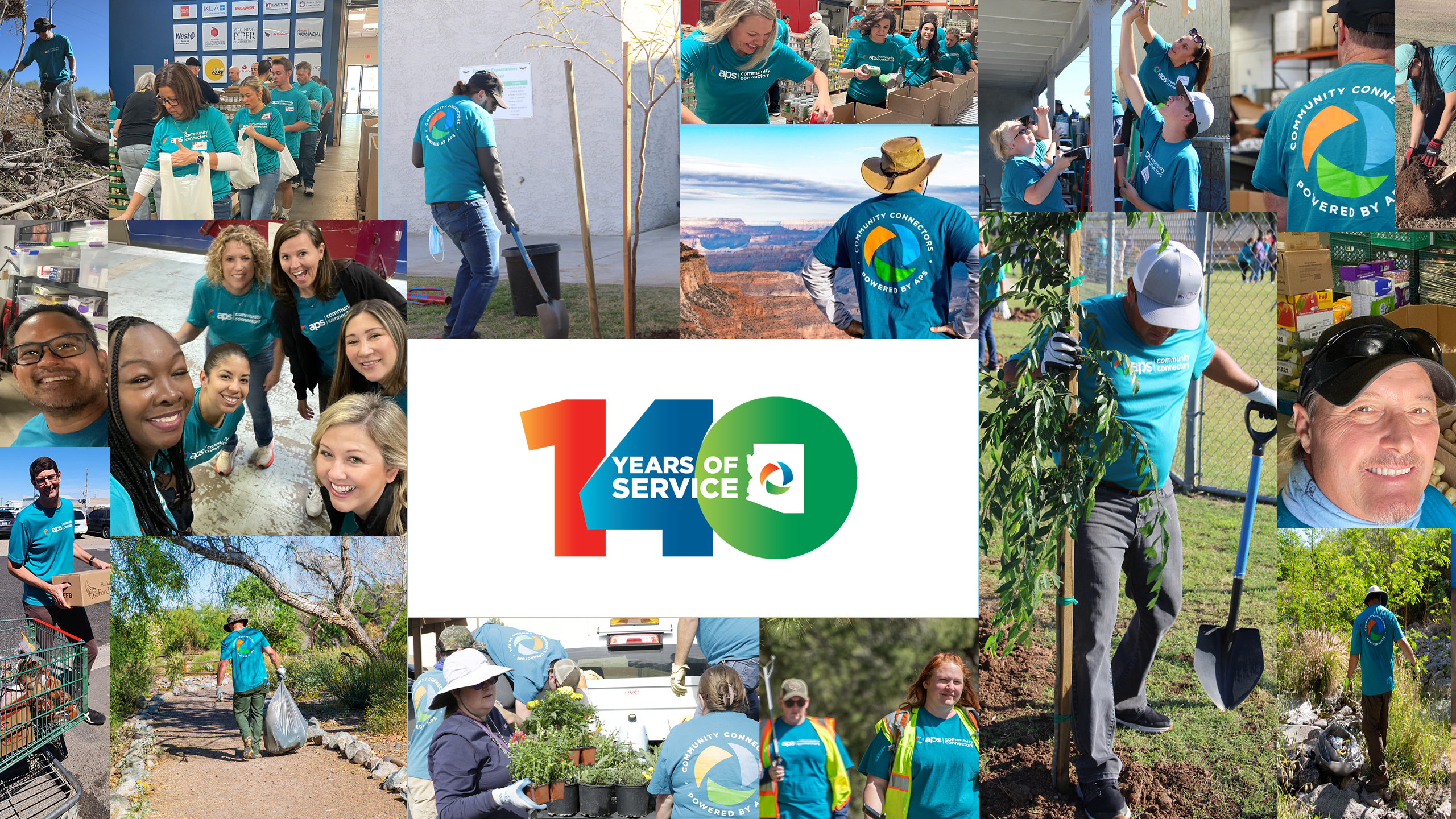
On April 29, APS employees will volunteer in communities statewide as part of the company’s largest-ever Day of Service. In a nod to its anniversary year, employees will plant 140 trees, participate in restoration projects with the Arizona Game & Fish Department and support multiple nonprofit organizations focused on community wellbeing.
“APS employees live, work and raise their families in the same communities we serve,” said Ted Geisler, APS President and CEO. “Our 140th anniversary will reflect who APS is at our core – people who care deeply about Arizona and believe that showing up, rolling up our sleeves and serving side by side makes our communities stronger.”
As Arizona experiences unprecedented population and energy growth, APS remains focused on delivering safe, reliable electricity at the lowest possible cost while planning thoughtfully for the future. That long-standing vision led to landmark investments such as the Palo Verde Generating Station, a first-of-its-kind nuclear power plant in the desert, operating on recycled wastewater and producing electricity for four million homes and businesses across the Southwest. The plant began operations in 1986 and positioned Arizona as a national leader in reliable, around-the-clock, carbon-free power.
From agricultural electrification in the early 1900s to present-day Arizona featuring world-class chip manufacturer Taiwan Semiconductor Manufacturing Company (TSMC), APS has shared in the journey to support job creation and economic development. As the state advanced with the rise of Phoenix Sky Harbor International Airport (1935), the cool breeze of in-home air conditioning (mid-1900s), the semiconductor boom of the ‘80s, and ongoing population growth, APS has modernized Arizona’s energy grid to reliably serve its customers.
“It’s been amazing to watch Arizona become a thriving hub for opportunity, innovation and community,” added Geisler. “Through it all, our focus has remained the same: showing up for Arizona with reliable power and being a good neighbor to the people who call this place home. Every household, school, hospital and business we serve depends on us. We are humbled by that responsibility and look forward to being a trusted partner long into Arizona’s future.”
After setting new peak demand records each of the past three summers – reaching 8,643 MW on Aug. 7, 2025 – APS expects peak demand to exceed 13,000 MW in the next 14 years alone, just a tenth of its 140-year existence.
APS THROUGH THE YEARS:
1886: On April 29, Hutchlon Ohnick, a Japanese immigrant, is granted Phoenix’s first electric franchise and forms the Phoenix Illuminating Gas and Electric Company.
1899: Phoenix Electric Light Co. purchases Phoenix Illuminating Gas and Electric.
1906: Phoenix Electric Light Co. merges with Pacific Gas & Electric Co. and operates under the Pacific Gas & Electric Co. name.
1908: Arizona Power Company begins construction on one of the first hydroelectric facilities in the West, the Childs plant along Fossil Creek (later joined by its sister plant, Irving).
1912: Statehood! On Valentine’s Day, Arizona officially becomes the 48th state in the nation.
1918: Rock Springs Café opens in Black Canyon City. The future pie destination is started by an Arizona Power Company employee.
1919: The Grand Canyon is dedicated as a National Park.
1920: Central Arizona Light & Power Co. (CALAPCO) is formed and soon acquires Pacific Gas & Electric Co.
1925: Arizona Edison Company is founded and over time acquires many southern Arizona electric companies.
1926: Route 66 is completed in northern Arizona. (America’s main street is celebrating its centennial!)
1930: West Phoenix Power Plant begins operation, playing a big role in supplying the power to manufacture B-17 bombers for World War II. This plant remains part of APS’s generation fleet today.
1930: Pluto is discovered by astronomers at Lowell Observatory in Flagstaff.
1935: City of Phoenix acquires ownership of Sky Harbor Airport, which later becomes one of the nation’s busiest airports.
1936: Hoover Dam opens (and Lake Mead is created), providing critical water supplies and large-scale hydropower to Arizona.
1941: Luke Air Force Base opens as a World War II training field, relying on power from APS predecessors.
1949: Northern Arizona Light & Power Company is organized by acquiring many northern Arizona electric companies.
1950: Phoenix population reaches 100,000 to become the largest city in the Southwest.
1952: On March 1, CALAPCO, Arizona Edison and Northern Arizona Light & Power merge to form the current day APS. At the time, APS served 114,000 customers with 324-MW capacity, laying the foundation for the electric utility that powers much of Arizona today.
1956: APS builds the Bright Angel Substation to power Grand Canyon National Park. It’s replaced by a new substation in 2024 that also provides power to Phantom Ranch at the base of the canyon.
1950s-1960s: Arizona begins to see a boom in population, made possible by the rise of electric-powered home air conditioning.
1960: The Ocotillo Power plant comes online in Tempe.
1968: The Phoenix Suns debut in the NBA. Over the years, APS and the Suns have partnered on solar installations and community basketball courts.
1984: APS sells its natural gas business to focus on electric service.
1985: AZP Group Inc. is formed as the holding company for APS. It would later become Pinnacle West Capital Corporation.
1985: After years of planning and construction, Central Arizona Project water is first delivered to Phoenix.
1986: The first unit begins operation at Palo Verde Nuclear Generating Station, which goes on to become the nation’s largest power producer and a critical source of clean energy.
1990: The hottest day on record in Phoenix occurs, reaching 122 degrees at Sky Harbor.
1998: The Arizona Diamondbacks begin play as an expansion team, with APS as an inaugural partner. Three years later, they’d win the World Series.
2005: APS surpasses one million homes and businesses served.
2005: APS closes the Childs and Irving plants and begins decommissioning, restoring the creek and surrounding area.
2016: APS enters the Energy Imbalance Market to support reliability and customer savings.
2020: APS gets more than half of its electricity from clean sources, including solar, wind and nuclear.
2021: Reliable and affordable energy attracts TSMC, the world’s largest chip manufacturer, to locate new factory in APS service territory.
2022: Estimated population tops five million in the Phoenix area, one of the fastest growing U.S. cities.
2023-25: With customer demand surging from a growing population and economy, APS secures the largest energy supply in company history.
2025: Customers set new back-to-back, all-time peak demand records, surpassing 8,600 MW.
APS 140 BEAUTIFICATION PROJECTS:
Projects are being funded by APS shareholders and will not impact customer rates.
Coolidge Regional Park Development (Coolidge, AZ) – APS is partnering with the City of Coolidge to support the transformation of a new regional park with amenities such as basketball and pickleball courts, designed to promote active lifestyles and serve as a long term community asset.
Eloy Downtown Gateway and Signature Sign (Eloy, AZ) – Eloy’s Main Street corridor will be revitalized to include a welcoming public gathering space and signature community sign, creating a more inviting entryway to one of the city’s unique attractions.
Joseph City Community Park Enhancements (Joseph City, AZ) – The park will receive upgraded gazebos, restrooms and lighting, repaired volleyball courts, new benches and tables, additional trees and undergo a volunteer cleanup.
Hunt Park Improvements (Holbrook, AZ) – The community gathering space will enjoy several improvements including resurfaced basketball and tennis courts, conversion of existing space to pickleball courts, an updated skate park, enhanced perimeter fencing, new gazebos and modern playground features such as a zipline.
Fred Harvey Farm Restoration (Chino Valley, AZ) – Chino Valley is reviving the historic Fred Harvey Farm through restoration of the original buildings and creation of a new interpretive trail highlighting the site’s cultural, economic and historical significance.
Schoolyard Habitats Education Initiative (Prescott, AZ) – APS is partnering with the Highlands Center for Natural History, Prescott Unified School District and Chino Valley School District to revitalize three Schoolyard Habitat sites and install a new one. The sites will feature native gardens, interpretive signage and hands-on learning tools, and be open to the public after school hours.
Western Heritage Center Exhibit Enhancements (Prescott, AZ) – Located in historic Whiskey Row, the museum will establish a dedicated exhibit on APS’s history and the electrification of northern Arizona, along with updates to existing displays at the venue.
Joe Orduño Park Improvements (San Luis, AZ) – APS is partnering with the city to revitalize Joe Orduño Park, a central gathering place for families and residents, with shade upgrades, building improvements and restoration of an unusable tennis court.
Pop Harvey Park Enhancements (Parker, AZ) – APS is supporting the relocation of two basketball courts to Pop Harvey Park, reopening a valued recreational resource while adding shaded seating and new benches, restoring access and connection within this community space.
Gila Bend Community Center & Walking Path (Gila Bend, AZ) – APS is partnering with the Town of Gila Bend to revitalize its community center and advance construction of a new walking and biking path, promoting healthy living while ensuring the community has a safe, welcoming space for recreation and connection.
Downtown Phoenix Cooling & Shade Canopies (Phoenix, AZ) – In partnership with Downtown Phoenix Inc. and the City of Phoenix, APS is supporting the installation of shade canopies at high-traffic downtown intersections to reduce heat exposure, enhance pedestrian safety and improve the overall visitor experience – transforming busy corridors into cooler, more comfortable community spaces.
George Washington Carver Museum Upgrades (Phoenix, AZ) – APS is funding critical infrastructure needs at this cornerstone of African American history and culture by upgrading the museum’s parking lot to improve access and safety, while enabling the Center to host community events that support long-term financial stability.
Related stories
4/30/2026
APS Day of Service Delivers Statewide Community Impact for 140th Anniversary

10/9/2025
APS Expands Support For Community and Utility Bill Assistance Programs
8/23/2022
APS awards grants to west valley nonprofit organizations
Stay up to date with our social channels


Newsroom
View up to date news, articles and stories related to APS in the community.



Copyright © 2026 APS. All rights reserved.


